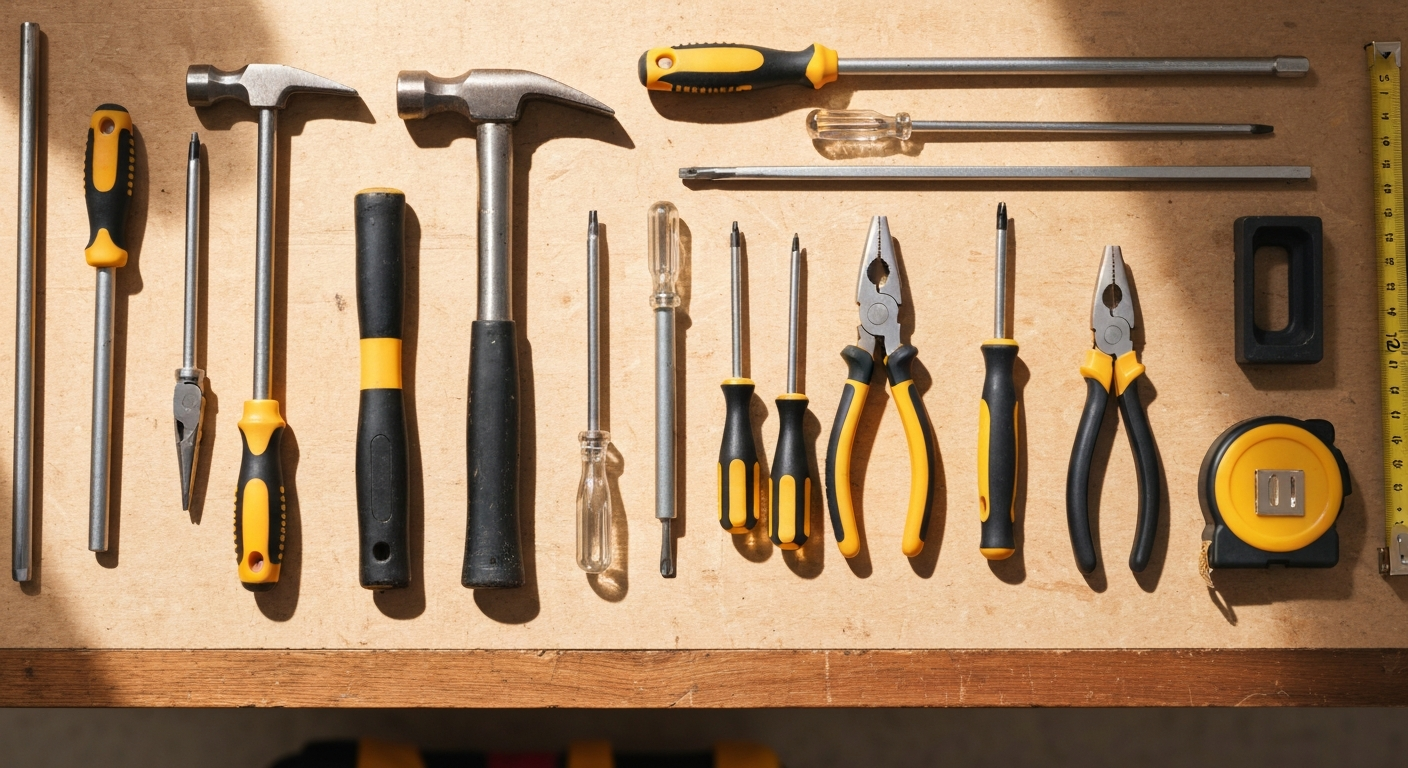
Whether you're a new homeowner in White City or have lived in your Saskatoon house for years, having the right tools on hand can save you time, money, and frustration. While you can't prepare for every possible home repair scenario, a well-stocked basic tool kit will enable you to handle many common household issues without calling a professional. This guide covers the essential tools every homeowner should have, organized by category and priority.
In Saskatchewan's extreme climate—where temperatures swing from -40°C in January to +35°C in July—homes experience unique stresses that lead to common repair needs. Foundation settling from clay soil, nail pops from over 100 freeze-thaw cycles annually, and drywall cracks from dramatic humidity changes all create situations where having the right tools readily available makes the difference between a quick fix and an emergency service call. A quality homeowner's tool kit typically costs between $150 and $400, which pays for itself after just a few DIY repairs that would otherwise require professional help at $80-$100 per hour.
These fundamental tools form the core of any homeowner's toolkit and can handle a wide range of tasks. Quality hand tools last decades when properly maintained, making them an excellent investment for Regina and Martensville homeowners alike.
Screwdrivers are perhaps the most frequently used tools in any home. A quality multi-bit screwdriver can replace an entire set, saving space and money. The Stanley 94-248 65-Piece Homeowner's Tool Kit includes a comprehensive selection of screwdriver bits and handles with ergonomic rubber grips that remain comfortable even in cold garage conditions. Expect to pay $8-$15 for individual quality screwdrivers or $25-$40 for a complete multi-bit set.
In Saskatchewan homes, you'll use screwdrivers constantly for tightening loose cabinet hinges (a common issue as homes settle on clay soil), adjusting door hardware that shifts during seasonal expansion and contraction, and assembling furniture. Keep magnetic-tip screwdrivers on hand for working in tight spaces where dropped screws become difficult to retrieve.
A 16-ounce claw hammer serves as the workhorse for hanging pictures, driving finishing nails into trim, and general repairs. The claw end allows you to remove nails and pry apart materials when needed. Look for hammers with fiberglass or steel handles rather than wood—they withstand Saskatchewan's temperature extremes better and won't crack or loosen in cold conditions. Quality hammers range from $20-$50, with brands like Estwing offering lifetime durability.
For Saskatchewan homeowners, a hammer becomes essential for addressing nail pops in drywall—a frequent issue caused by foundation settling and wood framing movement. Rather than simply hammering the popped nail back in (which will pop out again), use your hammer to countersink the nail slightly below the surface, then drive a drywall screw 2 inches above or below the original nail for a permanent fix.
Accurate measurements prevent costly mistakes when ordering materials or planning projects. Essential measuring tools include:
When working in unheated spaces during Saskatchewan winters, metal tape measures can become uncomfortable to handle. Consider models with rubber-coated cases that provide better grip in cold conditions. Levels with digital displays may experience slower response times below -10°C, so traditional bubble levels remain reliable for year-round use.
A basic pliers and wrench set handles everything from plumbing repairs to furniture assembly:
Saskatchewan homeowners frequently need these tools for tightening loose toilet connections, adjusting radiator valves in older homes, and addressing minor plumbing issues before they become emergencies. During winter, keep a pair of channel-locks accessible for quickly shutting off water supply lines if pipes freeze—knowing how to turn off water at individual fixtures or the main shutoff can prevent thousands of dollars in water damage.
A retractable utility knife with replaceable blades ($8-$20) handles countless tasks: opening packages, cutting drywall, trimming caulk, scoring vinyl flooring, and shaving door edges. Keep extra blades on hand (a 50-pack costs $10-$15) and change them frequently—dull blades require more pressure and increase injury risk.
For drywall repairs common in settling prairie homes, a sharp utility knife allows you to square off damaged areas cleanly, creating straight edges that accept patches more securely. When cutting drywall in cold basements, score multiple times rather than trying to cut through in one pass, as cold drywall becomes more brittle.
While power saws handle major cutting tasks, a quality hand saw ($20-$45) remains valuable for quick cuts, working in tight spaces, and situations where power tools aren't practical. A 15-inch crosscut saw with 8-10 teeth per inch works well for general carpentry, while a fine-tooth saw (12-14 TPI) produces smoother cuts in trim and molding.
Saskatchewan homeowners often need hand saws when repairing squeaky stairs—a common issue in homes built on clay soil foundations. Cutting small wood shims to fill gaps between treads and risers stops the rubbing that causes squeaks. Access the underside of stairs if possible, apply wood glue to shims, and tap them into place with your hammer for a permanent fix that takes under an hour.
A cordless drill represents the single most valuable power tool investment for homeowners. The Black+Decker LDX120PK 68-Piece Drill & Home Tool Kit offers an excellent starting point at $80-$120, including a 20-volt lithium-ion drill, driver bits, and basic hand tools. For more demanding tasks, consider 18-20 volt models from DeWalt, Milwaukee, or Makita ($150-$250 for drill only, $250-$400 for combo kits with impact driver).
Key features for Saskatchewan conditions include:
Use your cordless drill for hanging shelves, installing cabinet hardware, assembling furniture, and the critical task of securing loose drywall properly. When addressing nail pops, drill pilot holes slightly smaller than your screw diameter to prevent splitting wood framing in cold conditions when lumber becomes more brittle.
For homeowners planning larger projects like deck repairs or fence replacement, a 7.25-inch circular saw ($80-$200) cuts dimensional lumber quickly and accurately. However, this remains optional for basic home maintenance—most homeowners can have lumber cut to size at Home Depot or Rona when needed.
A non-contact voltage tester ($15-$35) is essential safety equipment for any electrical work. This tool detects live electrical current without requiring direct contact with wires, allowing you to verify power is off before changing outlets, switches, or light fixtures. Never attempt electrical work without first confirming power is disconnected—Saskatchewan follows the Canadian Electrical Code (CEC 2024), which requires proper safety procedures for all electrical modifications.
A quality LED flashlight ($20-$50) and hands-free LED headlamp ($15-$40) prove invaluable for working in crawl spaces, attics, and during power outages. Saskatchewan's long winter nights mean many repairs happen in darkness, and proper lighting prevents mistakes and injuries. Keep extra batteries stored at room temperature—cold batteries lose capacity quickly.
Given Saskatchewan's extreme temperature swings and settling clay soil, drywall damage occurs frequently in prairie homes. A basic drywall repair kit ($25-$50) should include:
Saskatchewan's dry climate causes joint compound to dry faster than in humid regions—monitor your work to avoid cracking and apply thin coats rather than attempting to fill deep holes in one application. For small nail holes under 1-2 inches, simply clean debris, apply spackle with your putty knife, let dry completely, sand smooth, and paint. Medium holes (up to 4-6 inches) require mesh patches or backing boards, while larger damage typically warrants professional repair at $200-$1,500 depending on scope.
A basic caulking gun ($8-$20) and tubes of paintable acrylic caulk ($4-$8 each) seal gaps around baseboards, trim, windows, and doors. In Saskatchewan homes, these gaps expand during winter as materials contract in extreme cold, then close partially in summer. Annual inspection and re-caulking of interior trim prevents drafts and improves energy efficiency.
For exterior applications, use polyurethane or silicone caulk rated for temperature extremes from -40°C to +80°C. Apply caulk when temperatures remain above 5°C for at least 24 hours to ensure proper adhesion and curing.
Electronic stud finders ($20-$60) locate wood framing behind drywall, essential for securely mounting heavy items like shelving, televisions, and cabinets. Basic models detect wood studs, while advanced versions also identify electrical wiring and metal pipes—valuable safety features when drilling into walls.
Saskatchewan homes built on concrete foundations typically have 16-inch or 24-inch stud spacing. Once you locate one stud, measure to find others. Always drill pilot holes when installing screws into studs, especially during winter when cold lumber becomes harder and more prone to splitting.
Proper tool storage extends tool life and ensures equipment remains accessible when needed. A basic plastic toolbox ($15-$40) works for starting collections, while homeowners with growing tool inventories benefit from rolling tool chests ($100-$300) or wall-mounted pegboard systems ($30-$80 for materials).
Saskatchewan's temperature extremes require special storage considerations:
Having the right tools enables many repairs, but recognizing when to call professionals prevents costly mistakes and safety hazards. Here's a practical breakdown for common Saskatchewan home repairs:
For professional assistance with any home repair needs, contact Hey Fix It Pro at 639-739-0855 for a no-obligation assessment and quote.
