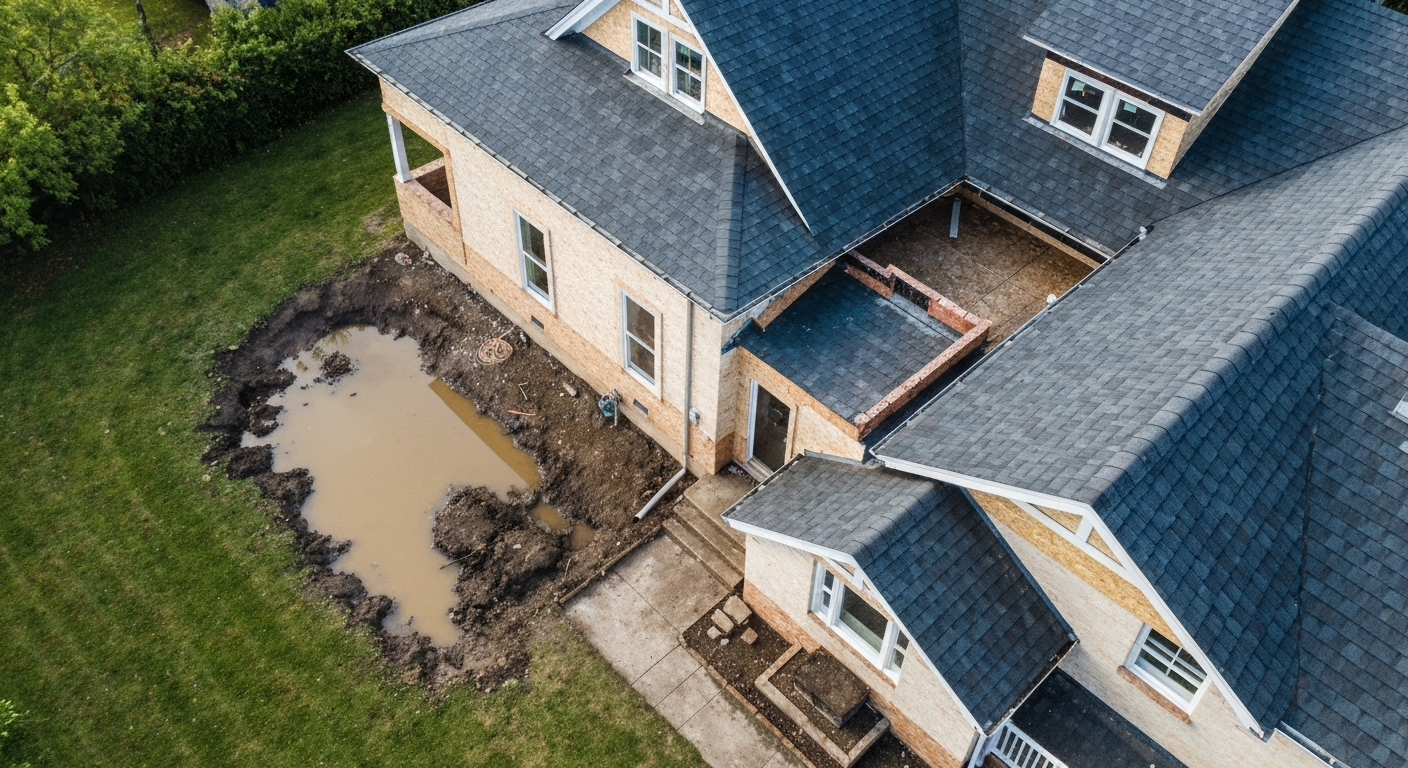
Of all the home maintenance tasks Saskatchewan homeowners are aware of — roof inspections, furnace filter changes, gutter cleaning — drainage and lot grading sits near the bottom of most lists. It's invisible. There's nothing that obviously needs replacing or cleaning. And the consequences of ignoring it don't announce themselves with a loud noise or an obvious failure. Instead, grading problems work slowly and silently, directing water toward your foundation week by week, year by year, until one day you have a damp basement, foundation cracks, or a mold problem that traces back to a lot grade that was inadequate years ago.
In Saskatchewan's climate — spring snowmelt on frozen ground, heavy summer thunderstorms, clay soils that don't absorb water quickly — drainage and grading deserve more attention than they typically receive. The province experiences over 100 freeze-thaw cycles annually, which means water that pools near your foundation doesn't just sit there harmlessly. It freezes, expands, thaws, and repeats this cycle dozens of times each year, creating hydrostatic pressure against basement walls and accelerating foundation deterioration.
The clay-based soils common throughout Regina, Saskatoon, Martensville, White City, and Pilot Butte compound the problem. Unlike sandy or loamy soils that absorb water relatively quickly, Saskatchewan's clay soil holds moisture, settles unevenly over time, and creates drainage challenges that persist for years after initial construction. This is why proper grading isn't just a nice-to-have — it's essential infrastructure that protects your home's structural integrity.
Saskatchewan Building Code, and the building codes of both Regina and Saskatoon, require a minimum lot grade slope of 2% away from all buildings for a minimum distance — approximately 1.5–2.5 metres from the foundation. This means a drop of at least 20mm per metre of horizontal distance away from the house. More specifically, the standard calls for a 25mm (1 inch) drop per metre, which translates to a 2.5% grade.
In practical terms, if you stand at your foundation wall and look outward, the ground should visibly slope away from the house. A flat yard is insufficient. A yard that slopes slightly toward the house is actively directing water to your foundation. For the first 1.5 metres adjacent to your foundation, Regina's municipal standards recommend a steeper 1:12 ratio slope where possible — that's approximately an 8% grade, or about 83mm of drop per metre.
Saskatoon's municipal standards add another requirement: lot elevations must be maintained at least 0.15 metres (150mm) above the 1-in-100-year high water level for the area. This reflects the reality that significant spring melt events in Saskatchewan are not rare — they occur regularly, and lot grading needs to provide a meaningful buffer. The City of Saskatoon's grading guidelines also specify that soil must slope away from foundation walls including areas under decks and steps, and that no structures like sheds should be placed within 300mm of property lines where they might interfere with drainage patterns.
Most Saskatchewan residential lots fall into one of two drainage design categories:
Understanding your lot type is essential when planning drainage improvements, because any regrading work needs to maintain the original municipal drainage design. Altering these patterns without proper engineering can redirect water onto neighboring properties and may violate municipal bylaws.
If you're experiencing multiple interior signs simultaneously, the problem has likely been developing for years. The good news is that addressing the exterior grading issue now can prevent further damage and may allow existing moisture problems to resolve naturally as the foundation dries out.
The City of Regina recommends that downspouts discharge a minimum of 1.0 metre from the foundation. This is a minimum — best practice is to extend discharge at least 2 metres (6 feet), particularly in yards where the natural grade doesn't carry water away strongly. Downspout extensions should be no higher than 0.6 metres above grade and should terminate at least 3 metres from property lines to avoid directing water onto neighboring lots.
A splash block at the point of discharge protects the soil from erosion and helps distribute the flow. These simple concrete or plastic pads cost $15-35 each and prevent the concentrated stream from your downspout from creating erosion channels that undermine your carefully established grade.
Many Saskatchewan homes built in the last 20–30 years experienced grading that met code at completion but degraded as fill soil settled. During construction, disturbed soil around a foundation is replaced with fill, which is compacted as best as possible but continues to settle for years. As this fill settles, the grade adjacent to the foundation often reverses from a positive slope (away from the house) to flat or slightly negative (toward the house). This is extremely common in newer developments throughout Martensville, White City, Pilot Butte, and newer subdivisions in Regina's east end and Saskatoon's Brighton and Rosewood neighborhoods.
If your home is 5–15 years old and you're experiencing basement moisture problems that didn't exist initially, settling of the original fill grade is a very likely contributing factor. The clay-based subsoil common in Saskatchewan settlements particularly poorly, creating those telltale settlement dips around the foundation perimeter.
Regrading requires adding topsoil and sometimes engineered fill to restore the original design grade — not a complex repair, but one that is overlooked far too often. The key is using the right materials: topsoil alone is insufficient for areas immediately adjacent to the foundation. You need clay-based fill or engineered fill that compacts properly and won't settle further. Topsoil should only be used for the final 100-150mm of grade where you'll be establishing grass or landscaping.
In yards where the terrain doesn't naturally allow surface runoff to drain away from the house, engineered drainage solutions may be necessary. A French drain is a trench filled with gravel and a perforated pipe that collects groundwater or surface water and redirects it to a lower point — a municipal storm inlet, a drainage swale, or a dry well. French drains are appropriate when the yard topography channels water toward the house and regrading alone isn't sufficient to redirect it.
In Saskatchewan's clay soil, French drains are particularly effective because they address both surface water and the subsurface moisture that clay holds. A properly installed French drain system around a foundation perimeter typically costs $50-100 per linear metre, meaning a full perimeter installation for an average home runs $5,000-15,000 depending on site conditions and depth requirements. This is significantly more expensive than simple regrading, but it's the appropriate solution when topography or lot constraints make surface drainage insufficient.
Many Saskatchewan lots are designed with drainage swales — shallow depressions running along property lines that carry surface water from multiple lots to a central drainage path. These swales are part of the municipal drainage design and are meant to be maintained by homeowners. A proper swale has an interior angle of at least 135 degrees and a width of approximately 0.5 metres per side, creating a gentle V-shaped channel.
Filling in a swale with landscaping, or allowing it to become overgrown and obstructed, can redirect drainage onto adjacent properties and increase foundation flooding risk for multiple homes. The City of Regina and City of Saskatoon have bylaws prohibiting alteration of municipal drainage patterns. If you're unsure whether a depression in your yard is a designed swale or just a low spot, your municipal drainage plan (available from the city) will show the intended drainage pattern for your lot.
Swale maintenance is straightforward: keep them clear of debris, don't fill them in with soil or landscaping materials, and ensure grass is kept mowed so water can flow freely. If a shared swale between properties has been compromised by a neighbor's landscaping, contact your municipality — these are regulated features, not optional elements homeowners can modify at will.
Drainage and grading problems and foundation problems are directly connected. Water that pools against a foundation exerts hydrostatic pressure on basement walls — the primary cause of horizontal foundation cracks and basement water infiltration. Over years, even low-level chronic moisture exposure can:
This is why drainage and grading, despite being unglamorous maintenance tasks, have some of the highest return on investment of any exterior work you can do. Addressing a grading problem before it causes foundation damage costs a fraction of what it costs to repair foundation damage after the fact. A $2,000-5,000 investment in proper grading can prevent $15,000-50,000 in foundation repair costs down the line.
| Solution | Cost Range (CAD) | Best For |
|---|---|---|
| DIY regrading (small area, topsoil only) | $500-$2,000 | Minor settlement dips, limited scope |
| Professional regrading (full perimeter) | $2,000-$5,000 | Settlement issues, grade reversal |
| French drain installation (per metre) | $50-$100 | Poor natural drainage, clay soil |
| French drain (full perimeter) | $5,000-$15,000 | Significant drainage challenges |
| Downspout extensions (DIY) | $200-$500 | Basic discharge improvement |
| Swale restoration/creation | $1,000-$3,000 | Lot line drainage issues |
| Splash blocks/pads | $15-$35 each | Erosion prevention at discharge points |
| Grading survey certificate | $500-$1,000 | Verification of code compliance |
These costs assume typical Saskatchewan conditions and may increase for properties with challenging access, extensive landscaping that needs to be worked around, or significant elevation changes. Projects requiring engineered fill, extensive excavation, or coordination with municipal storm sewer connections will be at the higher end of these ranges.
Homeowners with basic tools and physical capability can handle:
For small-scale DIY regrading, you'll need 10-20 cubic yards of topsoil (at $30-50 per yard delivered), basic landscaping tools, and the physical stamina for several hours of shoveling and raking. The work is straightforward but labor-intensive.
For professional assistance with any home repair needs, contact Hey Fix It Pro at 639-739-0855 for a no-obligation assessment and quote.
