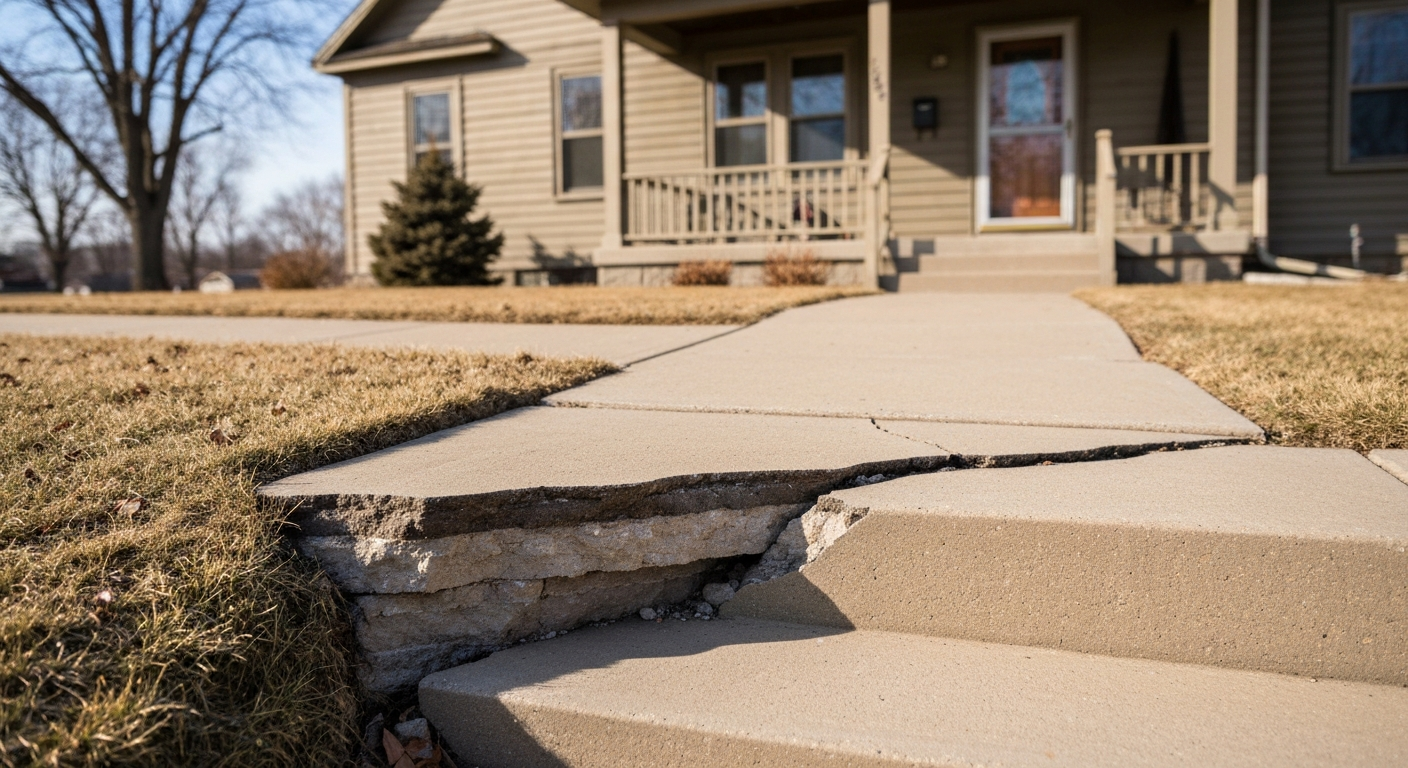
Heaved, cracked, and shifted concrete slabs are one of the most common exterior problems for Regina and Saskatoon homeowners — and one of the most misunderstood. Most people see cracked or heaved concrete and assume the concrete itself failed. In Saskatchewan, the concrete is usually fine. What's failing is the soil beneath it.
The root cause is a process called ice lens formation. When water in fine-grained soil (clay and silt are the main culprits in Saskatchewan) freezes, it doesn't freeze uniformly. Instead, water migrates toward the freezing front and forms discrete layers of nearly pure ice — ice lenses — that can be millimetres to centimetres thick. As these lenses grow, they push the soil upward. And anything sitting on top of that soil — a concrete sidewalk slab, front steps, a patio, or a driveway — gets pushed upward with it.
When spring thaw comes, the ice melts, the soil partially settles, but the slab often doesn't return to its original position. Instead, it settles unevenly, tilted relative to adjacent slabs or the structure it was attached to. Over multiple years of repeated heave-and-settle cycles, significant displacement accumulates.
Saskatchewan experiences more than 100 freeze-thaw cycles annually, with winter temperatures regularly dropping to -30°C to -40°C and frost penetration reaching depths of 1.8 to 2.4 meters in clay-heavy soils. This extreme environment creates conditions found in few other populated regions of North America. What might be a minor concrete issue in Vancouver becomes a significant structural challenge in Regina's Lakeview neighbourhood or Saskatoon's Stonebridge development.
Not all soils are equally susceptible to frost heave. Coarse sand and gravel drain freely and have low frost heave potential. Clay and silt soils — which dominate much of the Regina and Saskatoon areas — are among the highest frost-heave-risk soils in the country. They retain water, have fine enough particles to support capillary rise (drawing water upward from the water table toward the freezing front), and provide ideal conditions for ice lens growth.
Combine frost-heave-susceptible soil with 8–10 feet of frost penetration and you have conditions that challenge even well-constructed concrete flatwork over a decade or two of service. This isn't a failure of workmanship — it's the physics of the prairie climate applied to soil with these characteristics.
The Regina Plains and Saskatoon area sit on glacial till deposits left behind by retreating ice sheets. This till contains a high percentage of clay particles that act like tiny sponges, holding water molecules tightly. When temperatures drop below freezing, this trapped water expands by approximately 9%, creating tremendous upward pressure. A single cubic meter of saturated clay soil can exert several tons of lifting force when frozen — more than enough to displace a 100mm thick concrete slab weighing 240 kilograms per square meter.
Areas like White City and Pilot Butte, built on slightly different soil profiles with better natural drainage, often see less severe heaving than older Regina neighbourhoods like Cathedral or Al Ritchie, where decades of settlement have compressed subsoil and reduced drainage capacity. Similarly, Martensville's newer developments typically include better engineered base preparations than homes built in the 1960s and 1970s.
The classic Saskatchewan sidewalk problem: adjacent concrete slabs that were once level now have one slab raised 25–75mm above the other, creating a lip that is a trip hazard. This is the result of differential frost heave — one slab sitting over soil with slightly different drainage or moisture content than its neighbour, causing uneven uplift over multiple winters.
Under Saskatchewan's Occupiers Liability Act, property owners are responsible for maintaining safe conditions on their property, including sidewalks. A lip exceeding 13mm (half an inch) is generally considered a trip hazard that could result in liability if someone is injured. Regina and Saskatoon municipal bylaws require property owners to maintain adjacent sidewalks in safe condition, and documented trip hazards can result in fines ranging from $100 to $500 for initial violations, with higher penalties for repeat offences.
Concrete front steps often show a different failure mode: settlement, where the steps sink and pull away from the house foundation. This occurs because the steps are typically poured on disturbed fill soil placed when the home was built — fill that is more compressible and less stable than the native soil at depth. As this fill consolidates or loses moisture and shrinks, the steps sink. The gap between the steps and the house foundation is a classic indicator of this problem.
Steps can also heave upward on the opposite face from the house connection, particularly if the exposed concrete absorbs water and the soil beneath it freezes. The result is a rocking step — higher at the front in spring, settled at the front in fall.
Front steps present a particular challenge because they bridge between the deep, stable foundation of your home (typically extending below the frost line) and the shallow, frost-susceptible soil at grade level. This creates a structural conflict: the foundation doesn't move, but the soil around the steps does. Over time, this differential movement creates the characteristic gap or causes the steps to tilt forward, creating a safety hazard and allowing water to flow toward the foundation rather than away from it.
Concrete patios are large, heavy, and have multiple joints where differential movement can accumulate. A patio that drains poorly — pooling water rather than shedding it — is constantly introducing moisture into the soil below, creating ideal conditions for ice lens formation in winter and consolidation settling in summer. Cracks along control joints are expected; cracks across a slab mid-panel indicate significant movement.
Patios poured directly against house foundations are particularly vulnerable. The foundation wall acts as a dam, preventing water from draining away from the patio edge. This trapped moisture saturates the soil beneath the patio perimeter, leading to pronounced heaving along the house edge while the outer edge remains relatively stable. The result is a patio that slopes toward the house — exactly the opposite of what you want for drainage.
Concrete driveways crack from a combination of frost heave, vehicle load, thermal expansion and contraction, and age-related surface spalling from salt exposure. Saskatchewan roads use significant amounts of road salt, and this salt-laden water splashes onto driveway surfaces, accelerating surface deterioration. Driveway concrete that shows widespread surface scaling (pop-out of the surface layer) combined with cracking may not be worth repairing — replacement becomes more cost-effective than patching.
The weight of vehicles compounds frost heave damage. A typical passenger vehicle exerts 150-200 kPa of pressure on the driveway surface when stationary, and significantly more during braking or turning. When frost heave has already weakened the slab by creating voids beneath it, this vehicle loading can cause the concrete to crack along existing stress points. Driveways that show a combination of transverse cracks (across the width), longitudinal cracks (along the length), and corner breaks are typically beyond economical repair.
Mudjacking (also called slabjacking or concrete leveling) involves drilling holes through a settled or heaved slab and pumping a cement-soil slurry mixture beneath it under pressure to raise the slab back to its original elevation. It is significantly less expensive than replacement — typically $300–$800 for a typical residential application versus $2,000–$5,000 for full slab replacement — and the concrete can be used within 24 hours. The limitations: mudjacking fills the void but doesn't address the underlying drainage or soil conditions that caused the settlement; the repair may need to be repeated if those root causes aren't addressed. It also doesn't work well on severely cracked slabs where the integrity is already compromised.
For a standard 20 square meter sidewalk or step repair in Regina or Saskatoon, expect mudjacking costs of $3,000–$4,000, or approximately $100–$200 per square meter. This includes drilling 50mm holes through the concrete, pumping the slurry mixture, and patching the holes. The process typically takes 2-4 hours for a residential job, and the concrete can bear foot traffic within 24 hours and vehicle traffic within 48 hours.
A newer alternative is polyurethane foam lifting, which uses a two-part expanding foam rather than a slurry. It's lighter (less soil pressure), sets faster, and is less susceptible to washout, but the cost is typically higher than traditional mudjacking. Polyurethane foam lifting runs $200–$400 per square meter in Saskatchewan, making a 20 square meter repair cost $5,000–$8,000. However, the foam is waterproof, won't erode or wash out, and provides long-term soil stabilization that can prevent re-heaving — making it particularly effective in Saskatchewan's clay soils where traditional mudjacking slurry can be compromised by groundwater movement.
For sidewalk lips that are a trip hazard but where the underlying slabs are otherwise sound, grinding the raised edge flush is a fast, inexpensive solution. A concrete grinder reduces the trip hazard to near-zero. This addresses the symptom, not the cause, but for minor displacement (under 25–30mm) it is often the most practical and economical fix.
Professional concrete grinding typically costs $3–$6 per linear foot of joint in Saskatchewan, meaning a 10-meter sidewalk with three raised joints would cost approximately $100–$200 to grind flush. The work takes 1-2 hours and eliminates the immediate trip hazard, though the underlying heave issue remains and may worsen over subsequent freeze-thaw cycles. Grinding is best viewed as a temporary or cosmetic fix rather than a permanent solution, but it's highly effective at eliminating liability exposure quickly and affordably.
When slabs are extensively cracked, thin, or have heaved repeatedly, full replacement makes more long-term sense. A replacement pour should address the root causes: proper base preparation with crushed gravel to improve drainage and reduce frost heave susceptibility, correct slope for drainage, and adequate control joints to manage future cracking.
Full concrete replacement in Saskatchewan runs $250–$500 per square meter depending on site access, base preparation requirements, and concrete thickness. A typical 20 square meter sidewalk or step replacement costs $6,000–$10,000, including:
Properly installed replacement concrete should include 10M rebar at 600mm centers in both directions, placed at mid-depth of the slab. This reinforcement doesn't prevent cracking, but it keeps cracks tight and prevents differential movement between adjacent sections. Control joints should be cut or formed at intervals no greater than 2.4 meters (8 feet) in each direction, and joints should be sealed with polyurethane or silicone caulk to prevent water infiltration.
The Saskatchewan Home Renovation Tax Credit can provide up to $420 back (10.5% on up to $4,000 of eligible expenses) on qualifying concrete replacement projects, though the credit applies only to principal residences and has specific documentation requirements. Keep all receipts and contractor invoices to claim the credit on your provincial tax return.
The common thread in all concrete heave and settlement problems is moisture. Reduce the moisture in the soil beneath and around your concrete flatwork and you dramatically reduce the risk of frost heave. Practical prevention steps include:
For new concrete installations, the most effective prevention is proper base preparation. Remove all clay soil to a depth of at least 200mm below the finished concrete surface and replace it with free-draining crushed gravel (19mm clear stone is ideal). This creates a capillary break that prevents water from wicking upward from the clay subsoil into the zone directly beneath the concrete. In areas with particularly poor drainage, consider installing a 100mm perforated drain tile in the gravel base, sloped to drain away from the concrete.
Concrete work in Saskatchewan is highly seasonal. The ideal window is May through September, when daytime temperatures consistently stay above 10°C and nighttime temperatures remain above 5°C. Concrete needs temperatures above 10°C for proper curing — below this threshold, the chemical hydration process that gives concrete its strength slows dramatically or stops entirely.
Avoid concrete work in early spring (March-April) even if temperatures seem adequate. The soil is saturated from snowmelt, making proper compaction of base materials nearly impossible. Pouring concrete on saturated soil or poorly compacted base is a recipe for settlement problems within the first year.
Similarly, avoid concrete work in October and November. Early frosts can damage fresh concrete, and even if the concrete itself isn't damaged, the ground may freeze before the concrete fully cures, leading to bond failure between the concrete and the base material.
If emergency repairs are needed outside the ideal season, heated enclosures and concrete blankets can extend the working season, but expect to pay 20-30% more for winter concrete work due to the additional labor and materials required to protect the concrete during curing.
Some concrete maintenance tasks are reasonable DIY projects for homeowners with basic tools and skills. Others require specialized equipment, expertise, and insurance that only licensed contractors provide.
For professional assistance with any home repair needs, contact Hey Fix It Pro at 639-739-0855 for a no-obligation assessment and quote.
